The Crane That Folded in Half
a story about what bends on a journey — and what never, ever does
by Rayda Edding
Bismillah ir-Rahman ir-Raheem.
بِسْمِ اللَّهِ الرَّحْمَٰنِ الرَّحِيمِ
For every traveller Allah invited to go and look — and for the ones who stayed on the mountain.
The Man Who Found the Way
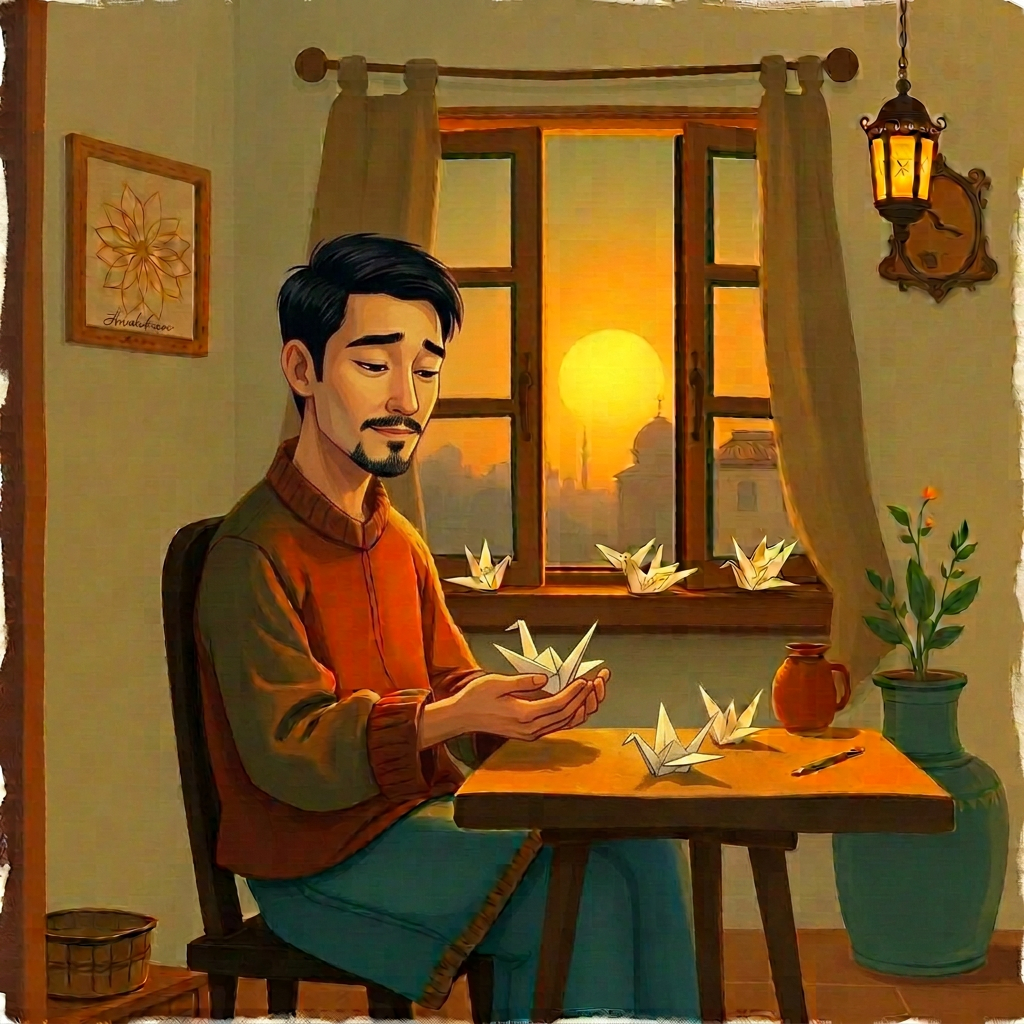
Kenzo-ojisan could fold a bird out of nothing.
Give him a square of paper — a receipt, a napkin, the corner of a menu — and in about a minute his big careful fingers would fold, and fold, and fold, and set down a little paper crane that looked as if it might, at any moment, decide to fly.
He had been folding cranes his whole life, long before he was a Muslim.
Because — and this is a thing worth knowing about Kenzo-ojisan — he was not born knowing the way to Allah. He found it. He grew up in a house with no prayer mat in it, in a family that had never heard the adhan, and one long year, when he was a grown man, he went looking for something true. He read. He asked. He sat quietly in the back of a masjid with his shoes in his hands, not sure if he was allowed in.
And then one ordinary afternoon he put his forehead on the ground for the very first time, and something in his chest that had been folded up tight his whole life — finally opened.
Kenzo-Ojisan liked to say that becoming Muslim was the longest journey he ever made, and he made it without moving his feet.
Then he married Khala Noura, who laughed at all his jokes and could not fold a crane to save her life, and the two of them were so happy that they were almost annoying about it.
And one evening Kenzo-ojisan folded a fresh white crane, set it in Khala Noura's palm, and said the six words that this whole story grows out of:
"Habibti. I want you to meet my family."
The Longest Flight
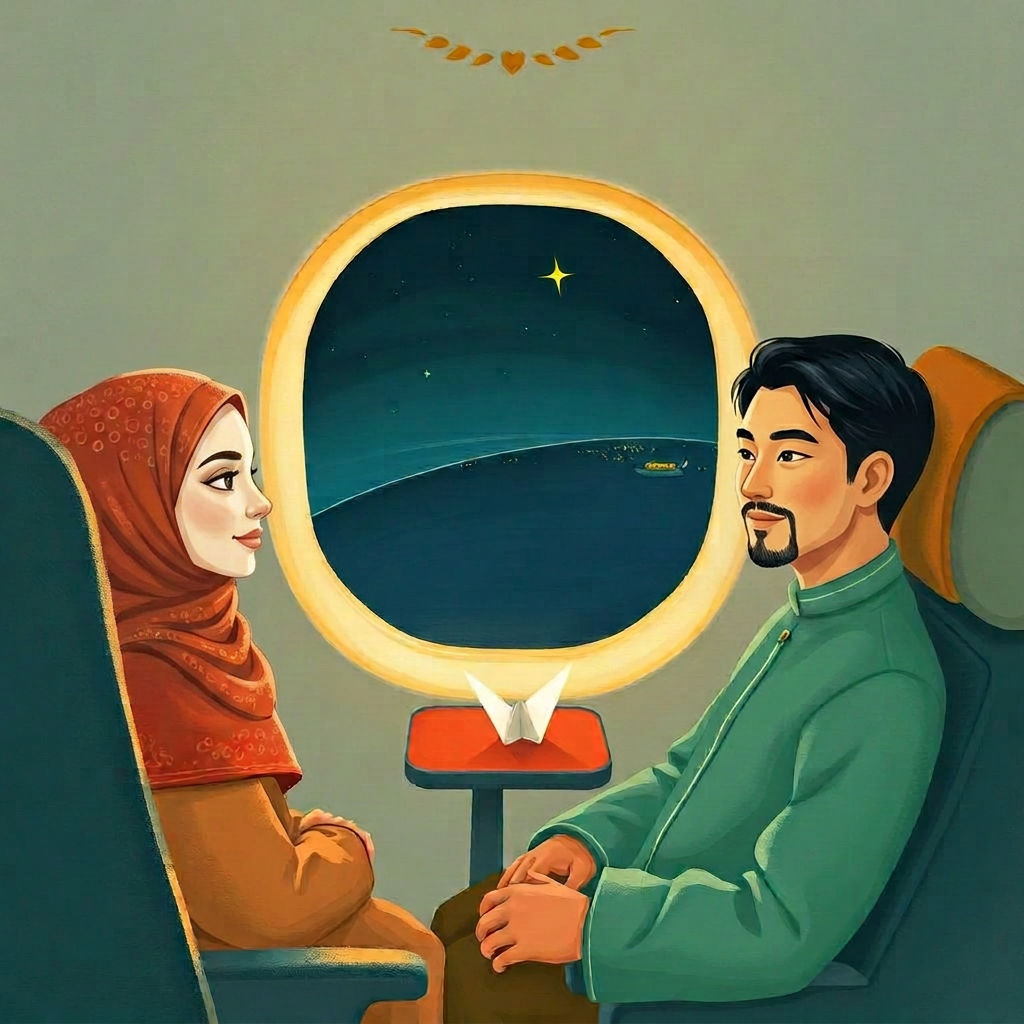
Kenzo-ojisan's family lived very far away, in Japan.
So one grey morning Kenzo-ojisan and Khala Noura packed one small bag each, and they got on a plane, and the plane climbed up and up until the clouds were underneath them, which Khala Noura thought should not be allowed and was wonderful.
Now — some people think travelling is just something you do to get somewhere. Kenzo-ojisan did not think that. Kenzo-ojisan thought travelling was something Allah actually asked him to do. And he was right.
Because Allah says it in the Quran, plainly, like an invitation with your name on it:
قُلْ سِيرُوا فِي الْأَرْضِ فَانظُرُوا كَيْفَ بَدَأَ الْخَلْقَ
“Say: travel through the land and observe how He began creation.”
— Surah Al-Ankabut (29:20)
Travel. Look. See how I began all of it.
"Noura," said Kenzo-ojisan, pressing his finger gently to the cold window, where a whole ocean was crawling past in the dark, "Allah did not put mountains and seas and cherry blossoms on the other side of the world by accident. He put them there so somebody would get on a plane, and go, and look — and say Alhamdulillah in a brand-new place."
Khala Noura looked down at the sleeping earth.
"So this whole trip," she said slowly, "is kind of… an ibadah?"
"This whole trip," said Kenzo-ojisan, folding the crane's wing a little sharper, "is kind of an ibadah."
The Land Like a Painting
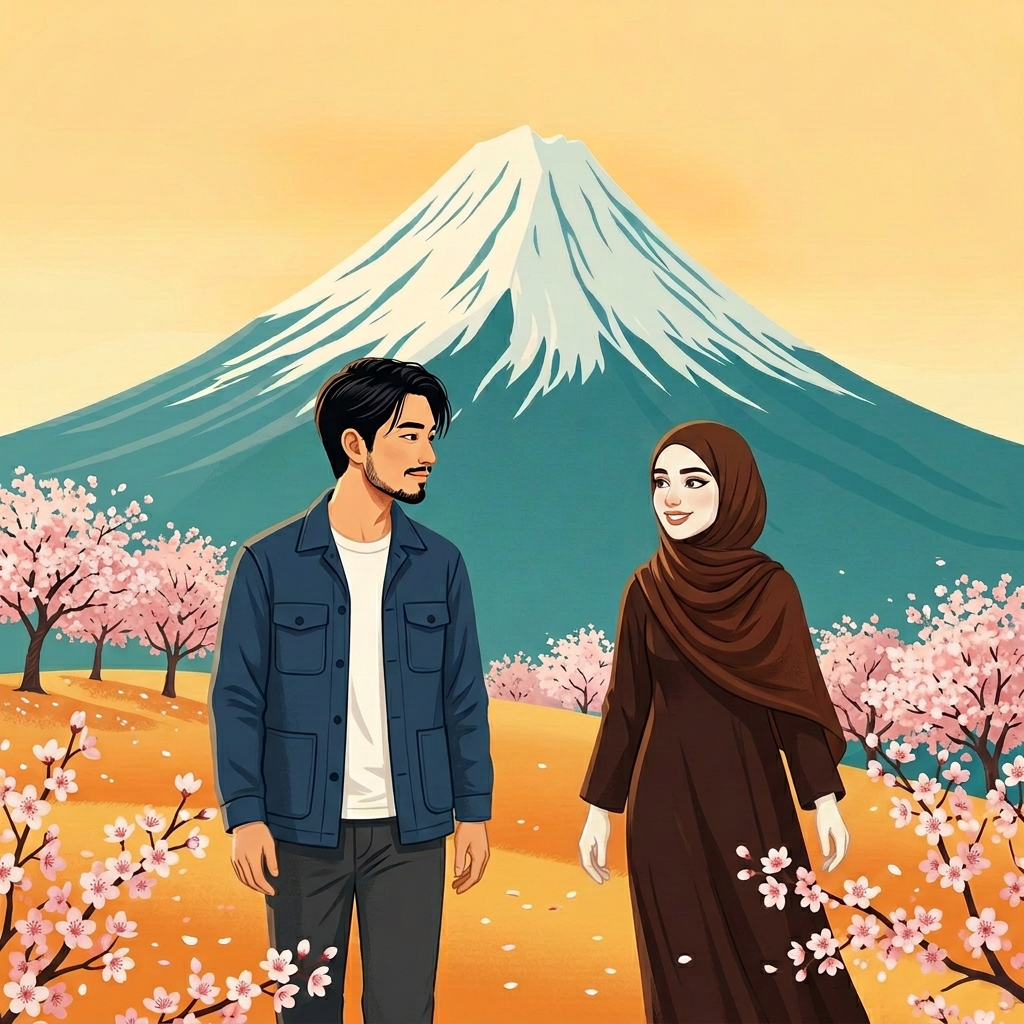
When they landed, Khala Noura understood exactly why Allah had told her to come and look.
Because Japan looked like a painting Allah had done on His very best day.
There were mountains with snow on the top and green all the way down. There were trees that dropped soft pink blossom like the sky was gently taking itself apart. There was a mountain so tall and so perfect — Fuji-san, Kenzo-ojisan called it — that Khala Noura actually put her hand over her mouth.
And every single time she gasped, Kenzo-ojisan would smile and say the same thing, very quietly: "Subhan'Allah. Look what He began."
Kenzo-ojisan's family was waiting for them, and they were not Muslim, and they were kind.
There was Obaachan — Kenzo-ojisan's little grandmother, who held Khala Noura's face in both her hands the way grandmothers do in every country on earth. There were aunties and cousins who bowed, and smiled, and did not know a single word of Arabic — but who had cooked, and cleaned, and set out their best cushions, because the boy who went far away had come home and brought a wife.
Khala Noura could not speak their language. But she understood love perfectly well. It turns out you do not need a translator for that.
The Menu With the Traps

That night, the family took them out to eat, and the table filled up with the most beautiful food Khala Noura had ever seen.
Tiny bowls. Steam curling up like smoke. Colours she did not have names for.
And Kenzo-ojisan, very quietly, leaned close to her ear and became her map.
"That onigiri — yes. Rice wrapped in seaweed, you're safe. That bowl of tonkotsu ramen — no, habibti. The broth is simmered from pork bones for hours." His finger drifted, gentle, unhurried. "That katsudon is breaded pork over rice — we leave it. And be careful of the shoyu ramen too, sometimes the chashu on top is pork belly. That teriyaki sauce has mirin and cooking sake stirred into it — we leave it. This yakizakana — the grilled mackerel — beautiful, go ahead. That nikujaga stew, no — the beef is often simmered in sake. And that tempura looks lovely, but ask if the dipping sauce has mirin in it. Give me a second and I'll ask what's in each one."
Because here is the thing Kenzo-ojisan knew, and taught Khala Noura that night with his soft, careful voice:
Two things on that whole gorgeous table, a Muslim never, ever eats.
Pork — the meat of the pig. And khamr — wine, and anything that makes the mind go fuzzy and foggy.
Not because they always look scary. Sometimes they hide. Sometimes the pork is a whisper in the bottom of a soup, and the wine is a splash cooked into a sauce that smells like heaven.
But Allah said it, clearly, so that His travellers would always know:
إِنَّمَا حَرَّمَ عَلَيْكُمُ الْمَيْتَةَ وَالدَّمَ وَلَحْمَ الْخِنزِيرِ
“He has only forbidden you carrion, blood, and the flesh of swine.”
— Surah Al-Baqarah (2:173)
And about the wine, and everything like it:
رِجْسٌ مِّنْ عَمَلِ الشَّيْطَانِ فَاجْتَنِبُوهُ
“…an impurity from the work of Satan, so avoid it.”
— Surah Al-Ma'idah (5:90)
Khala Noura did not feel sad, sitting at that shining table, quietly choosing. She felt looked after. As though somebody who loved her had drawn a little fence around her, in a country where she couldn't read the signs.
Why the Mountain Does Not Fold
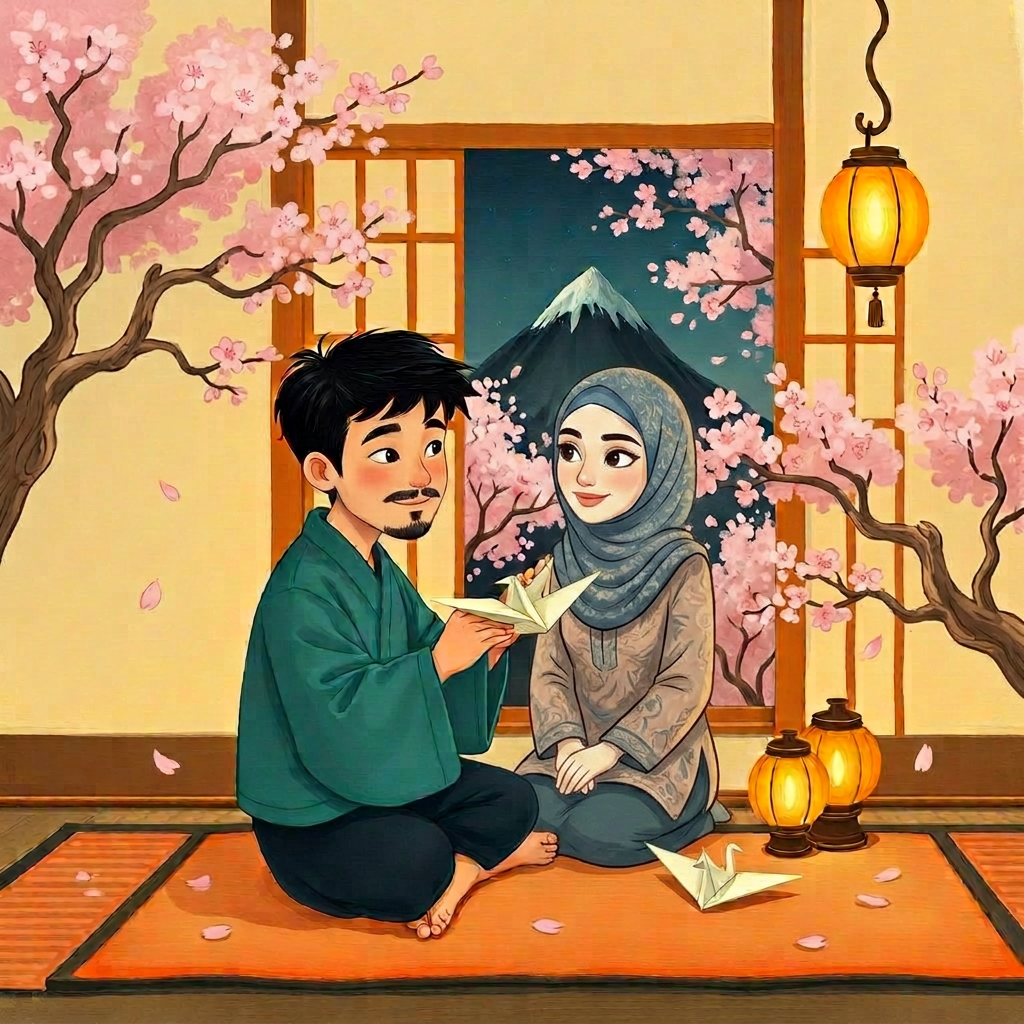
Later, back at Obaachan's, Khala Noura asked the question quietly, so the family wouldn't hear.
"Kenzo… why is Allah so firm about those two? He forgives so much. He's Ar-Rahman. Why not those?"
Kenzo-ojisan picked up a square of paper.
"Two reasons, habibti. First — because He loves you, and He can see what you can't. He knows what the wine does to a person, slow and quiet, until they forget their own prayer and their own children. He is not keeping something from you. He is keeping something away from you. There's a difference."
He folded the paper once.
"And second — look how gently He even gave the rule. Do you know that Allah did not forbid the wine all at once? He knew it was hard. So He told the people slowly — first that there was harm in it, then not to pray while their minds were foggy from it — and only at the end did He say: now, leave it completely. Step by step. Like teaching a child to walk. Even when Allah makes a hard rule, Noura, He makes it kindly."
Then Kenzo-ojisan held up the finished crane — and then, very deliberately, he folded it flat in half.
"Some things on a journey, Allah lets you fold. Make them lighter. Easier. You'll see, tomorrow." He set the folded crane down and pointed out the window, to the great black shape of the mountain that sat there, exactly where it had sat for ten thousand years.
"But some things are the mountain, habibti. And the mountain does not fold. Not in Japan. Not anywhere. And that, too, is His mercy."
The Prayer That Folded in Half
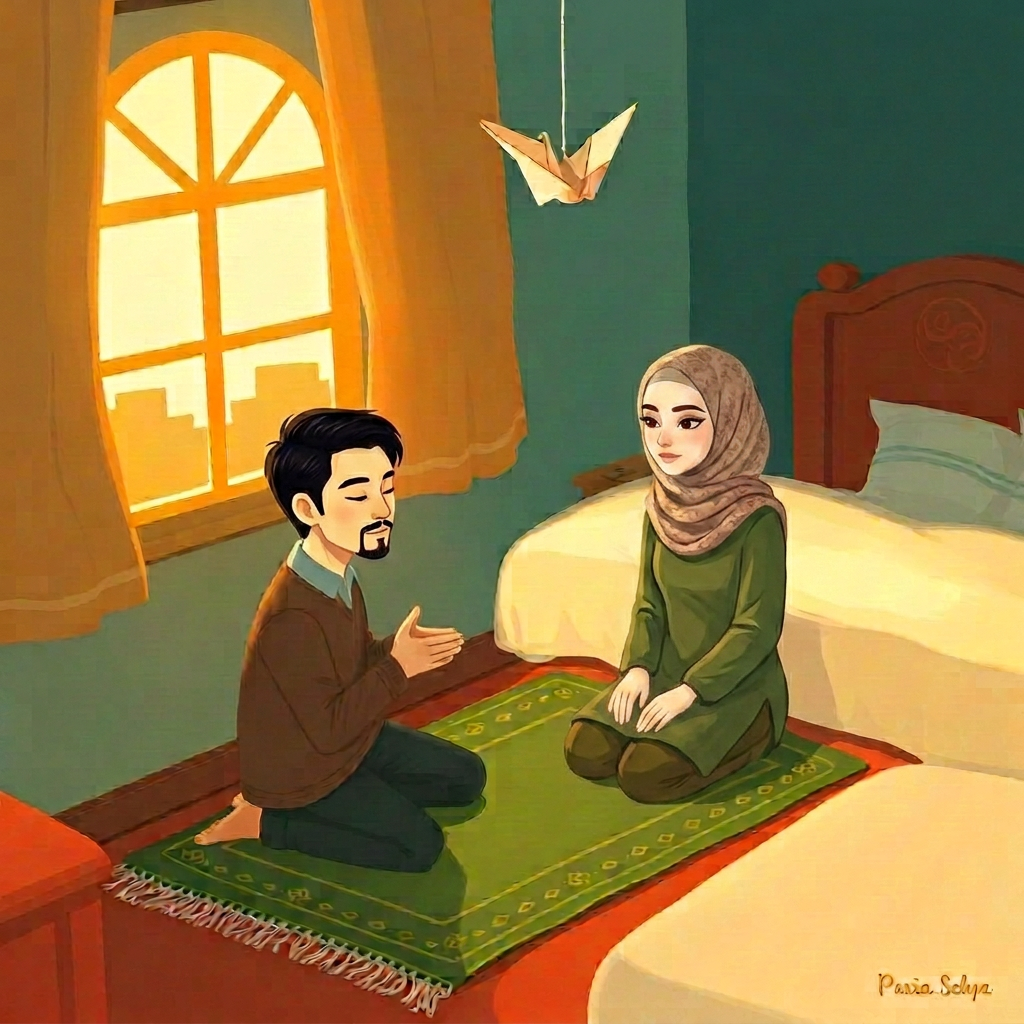
The next evening, it was time to pray.
And Khala Noura went to stand for Isha — four rak'ahs, the way she always prayed it at home — when Kenzo-ojisan touched her sleeve and smiled.
"Tonight, we pray two."
"Two?" Khala Noura blinked. "But Isha is four."
"At home, yes. But we're travellers now, habibti. And Allah, out of His mercy, folds the prayer in half for the one on a journey. Four becomes two. He said so in the Quran."
وَإِذَا ضَرَبْتُمْ فِي الْأَرْضِ فَلَيْسَ عَلَيْكُمْ جُنَاحٌ أَن تَقْصُرُوا مِنَ الصَّلَاةِ
“And when you travel throughout the land, there is no blame upon you for shortening the prayer.”
— Surah An-Nisa (4:101)
"And our Prophet ﷺ did it his whole life. Listen —"
“I accompanied the Messenger of Allah ﷺ, and on a journey he never prayed more than two rak'ahs. And Abu Bakr, and 'Umar, and 'Uthman did the same.”
— Ibn 'Umar · Sahih al-Bukhari; Sahih Muslim
Khala Noura stood on the little prayer mat by the window, and prayed two rak'ahs of Isha, and it was like the whole prayer had gently folded its wings in.
And when she finished, she understood something that made her eyes sting.
"Kenzo," she whispered. "This is a gift. He's not asking me for less because He loves me less. He's making it lighter because He knows I'm tired and far from home."
Kenzo-ojisan nodded, because that was exactly it.
"And do you know," he said, "the Prophet ﷺ told us Allah actually loves it when we take the eases He offers us? He gives you the fold on purpose, habibti. It hurts His generosity when you refuse it."
The crane on the windowsill sat folded neatly in half, and looked, if anything, even more like a bird about to fly.
Obaachan's Bowl
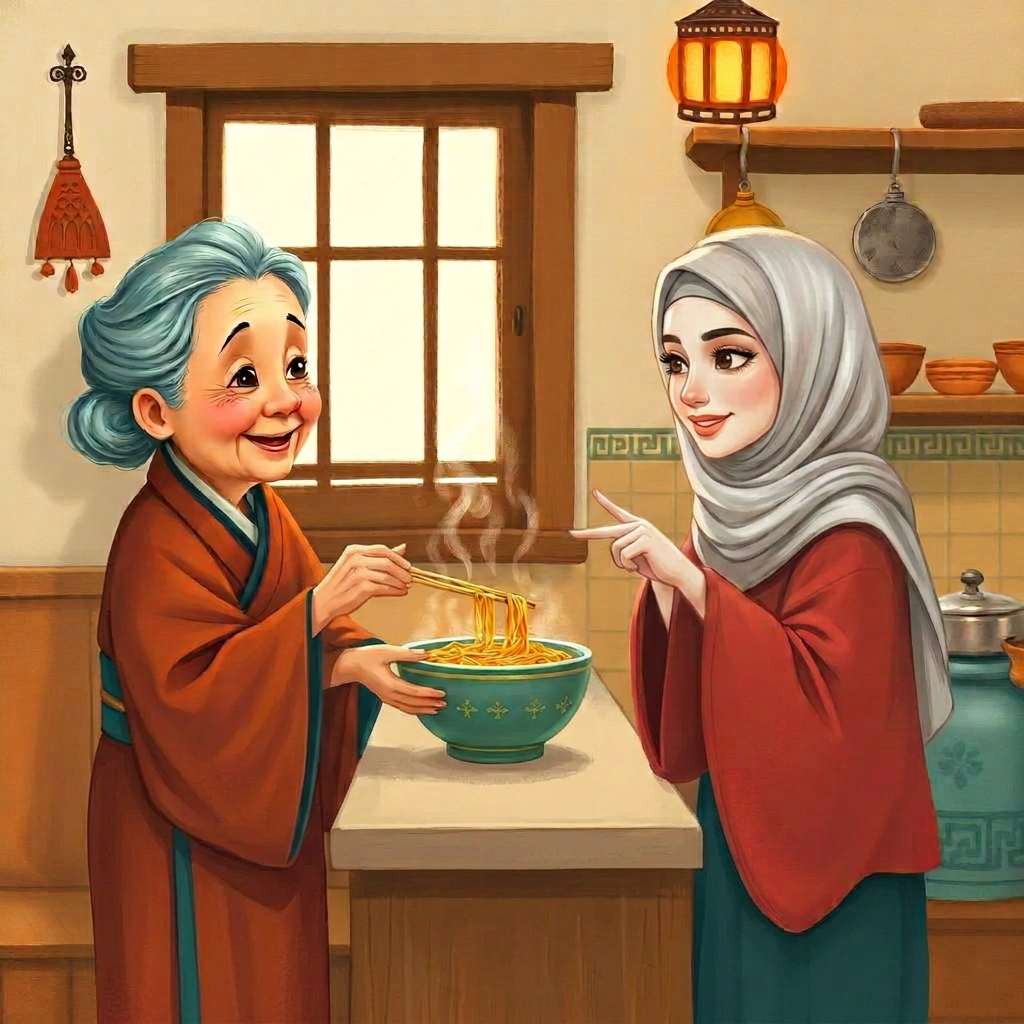
On the last morning, something happened that Khala Noura never forgot.
She came down early and found Obaachan already awake, already busy, standing on her tiptoes at the stove, cooking.
And when Khala Noura sat down, the little grandmother set a bowl in front of her — a beautiful, steaming bowl — and pointed at it, and then pointed at herself, and said one word she had made Kenzo-ojisan teach her the night before, in careful, wobbly Arabic:
"Halal."
She had cooked the whole thing without any pork. Without any wine. She had asked Kenzo-ojisan a hundred quiet questions and thrown out a sauce she'd used for forty years and started again, at her age, at dawn — so that the wife of her grandson could eat at her table without a single worry in her heart.
Khala Noura looked at that little bowl and could hardly breathe.
Because this is what Kenzo-ojisan's beautiful, patient, gentle way of living had done. He never lectured his family. He never made them feel small. He just prayed his two rak'ahs, and chose his food quietly, and folded his little cranes — and lived his deen so kindly that his grandmother learned an Arabic word at eighty years old, just to love him better.
That is dawah you cannot argue with. That is a whole family, watching a good man, and softening.
Kenzo-ojisan came in, saw the bowl, saw Obaachan's shy proud face — and this young man in his late twenties folded down over his tiny grandmother's hands and pressed them to his forehead.
The Crane That Flew Home
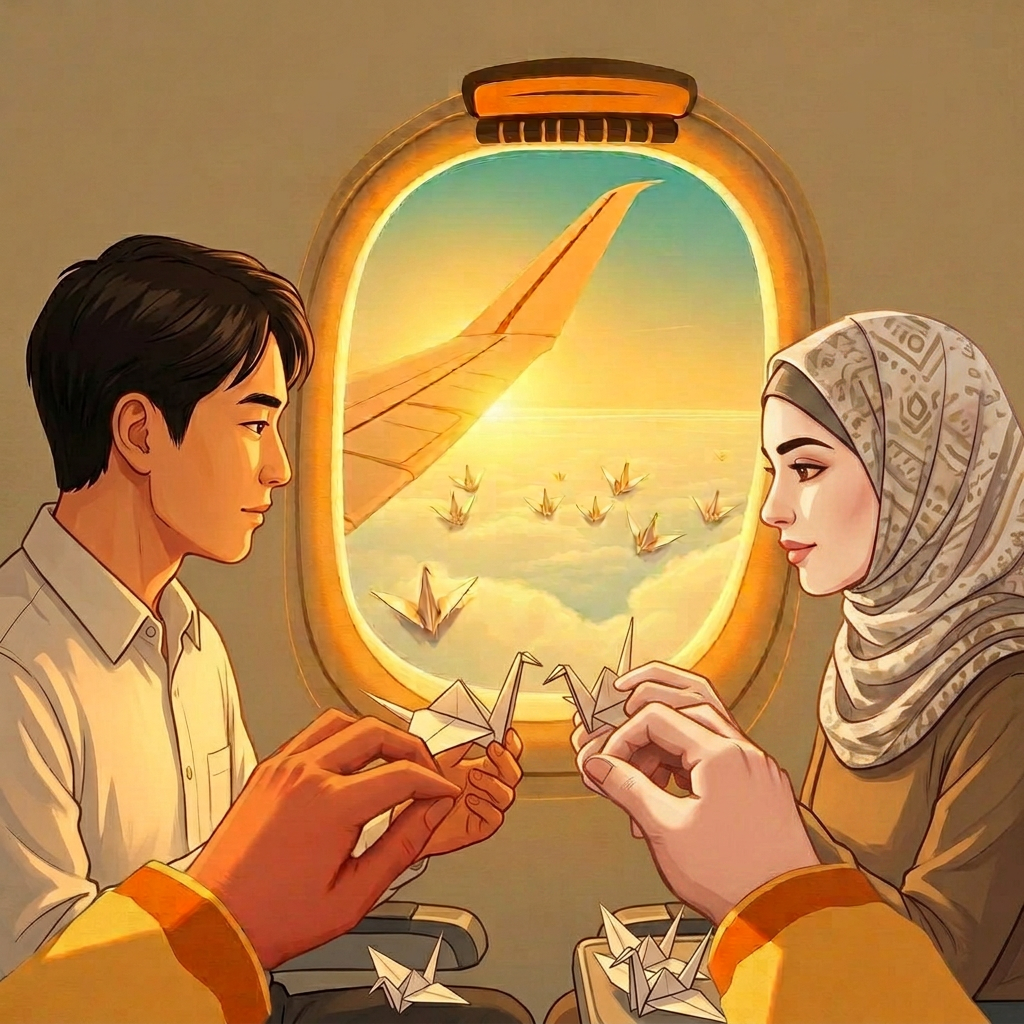
They flew home.
And somewhere over the wide gold ocean, Khala Noura sat with a square of paper in her lap, and — for the very first time, with Kenzo-ojisan guiding her clumsy fingers, fold by fold — she made a crane of her own. A lopsided, slightly squashed, entirely wonderful crane.
And she finally understood the whole thing. The thing Kenzo-ojisan had been showing her since the very first day.
A journey is full of things that fold. The prayer folds — four into two — because Allah is merciful and knows you are tired. The whole hard world folds a little lighter for a traveller, out of nothing but His kindness.
But some things are the mountain.
The pork does not fold. The wine does not fold. Not in Japan, not in a beautiful restaurant, not even at a grandmother's table — because those, too, are His mercy, drawing a gentle fence around the people He loves.
And the travelling itself? That was never just a holiday.
Say: travel through the land, and observe how He began creation.
Khala Noura had gone out to look at Allah's world.
And she had come home carrying a folded prayer, a fence made of love, a grandmother's halal bowl, and one small, squashed, perfect paper crane — with one end of it, like everything else, tied quietly to His Name.
What Folds, and What Does Not
For every journey, big or small.
- The prayer folds. On a journey, Dhuhr, 'Asr and Isha become two rak'ahs instead of four. Not a punishment — a gift. Take it. Allah loves it when you do.
- The tiredness folds. Being far from home is hard, and Allah made the whole faith a little lighter for the traveller. He sees you.
- The pork does not fold. Not hidden in a broth. Not on the best table you've ever seen. Ever.
- The wine does not fold. Not splashed in a sauce, not "just a little." The mountain stays where it is.
- And the looking never stops. Everywhere you go — a mountain, a blossom, a sea — say Subhan'Allah, and look at how He began it.
سُبْحَانَ الَّذِي سَخَّرَ لَنَا هَٰذَا وَمَا كُنَّا لَهُ مُقْرِنِينَ وَإِنَّا إِلَىٰ رَبِّنَا لَمُنقَلِبُونَ
Subhaana-lladhi sakhkhara lanaa haadha wa maa kunnaa lahu muqrineen, wa innaa ilaa Rabbinaa la-munqaliboon.
Glory to the One who has placed this at our service, and we could never have done it ourselves. And indeed, to our Lord we are surely returning.
O Allah, wherever we travel on Your wide and beautiful earth, keep our food clean and our prayer standing. Let us take the eases You love to give, and never bend on the two things You forbade out of love. Make our good manners a door for the people who watch us — as You did for Kenzo-ojisan. And bring us home safely, Ya Rahman, with our hearts fuller than when we left.
Ameen.
For Little Travellers to Try
- 1
Learn the two mountains. Say them out loud, so you'll always know: no pork, no wine. Everywhere. Every time. Some rules are mountains, and mountains keep you safe.
- 2
Learn the fold. When your family travels, ask them: "Are we praying Qasr?" Four rak'ahs becoming two is a present from Allah for people on a journey. Presents are meant to be taken.
- 3
Be a "what's-in-it" detective. Before you eat somewhere new, it is brave and beautiful — not rude — to ask what's inside the food. Kenzo-ojisan did it his whole life.
- 4
Travel to look. Next time you see a mountain, a sea, a sky full of stars, or one perfect flower — stop. Say Subhan'Allah. You just did the ibadah of Surah Al-Ankabut.
- 5
Do dawah the Kenzo-ojisan way. You almost never need to argue. Just live your deen so kindly and so beautifully that the people who love you soften — like a grandmother learning a new word at eighty, just to feed you right.