The Girl Who Was Never Taught
a story about what children learn when nobody is teaching
by Rayda Edding
Bismillah ir-Rahman ir-Raheem.
بِسْمِ اللَّهِ الرَّحْمَٰنِ الرَّحِيمِ
For Aisha, who dreams in Uyghur — and for every parent who thinks the lessons have not started yet. They started a long time ago.
Seventeen Times a Day
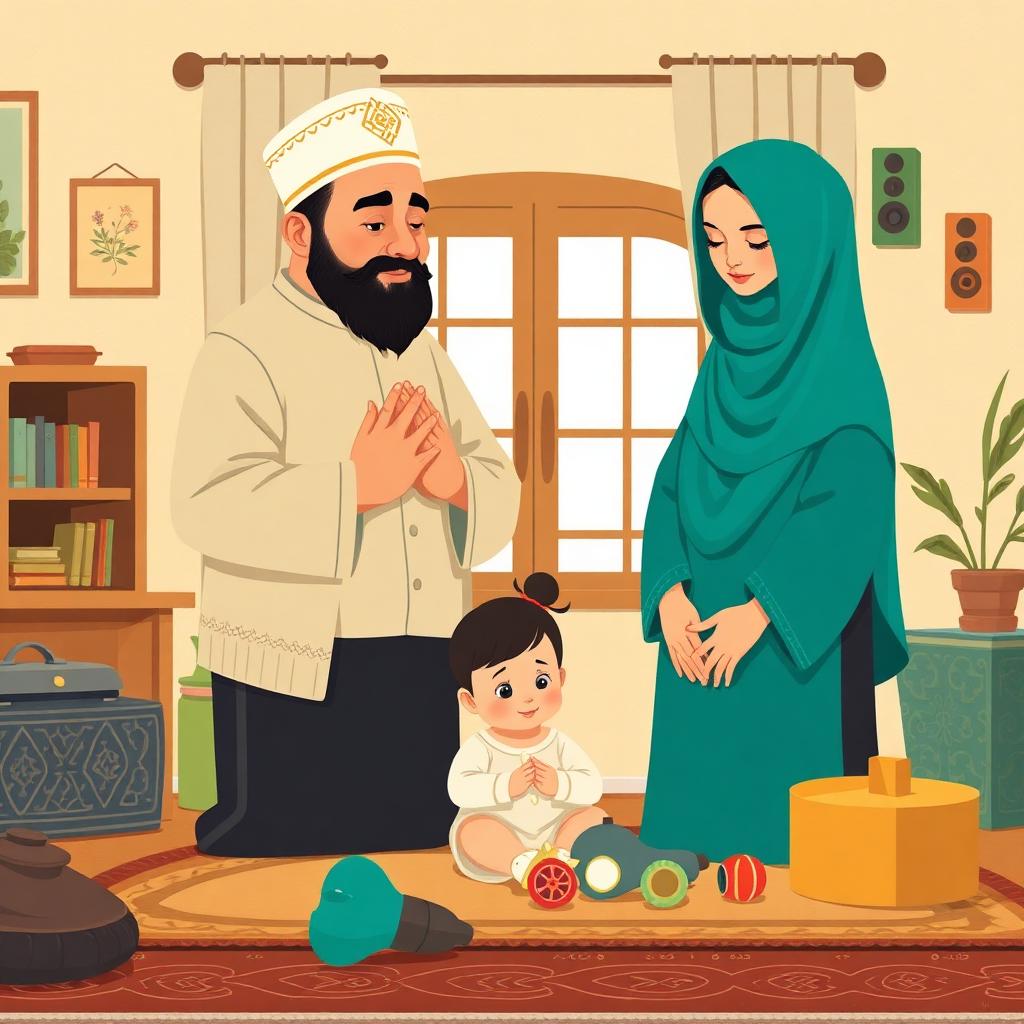
Aisha was one and a half years old.
She could not read. She could not write. She could not tie a shoe, or count past two, or explain a single thing to you about anything at all.
She had approximately eleven words, and four of them were "no."
But there was something about Aisha worth sitting down for.
Aisha had heard Surah Al-Fatiha seventeen times a day, every single day, since the day she was born.
Seventeen.
Because that is how many times it is recited in the five daily prayers — two in Fajr, four in Dhuhr, four in Asr, three in Maghrib, four in Isha.
Seventeen times a day. Every day. Since her very first one.
Nobody sat her down. Nobody quizzed her. Nobody made a chart with stickers on it.
She just… lived in a house where it happened. A house that smelled of cumin and lamb and the steam rising off a big plate of polo, where Baba Omar called her balam and kichkine — my little one — and Mama Saff called her qizim, my daughter, in a voice like warm bread.
The adhan came through the speaker. Baba Omar stood up. Mama Saff stood up. The words began — Alhamdulillahi Rabbil 'alameen — and a very small person on the carpet, surrounded by her toys and a half-eaten piece of naan, heard them again.
And again.
And again.
And nobody thought she was learning a single thing.
The Watching
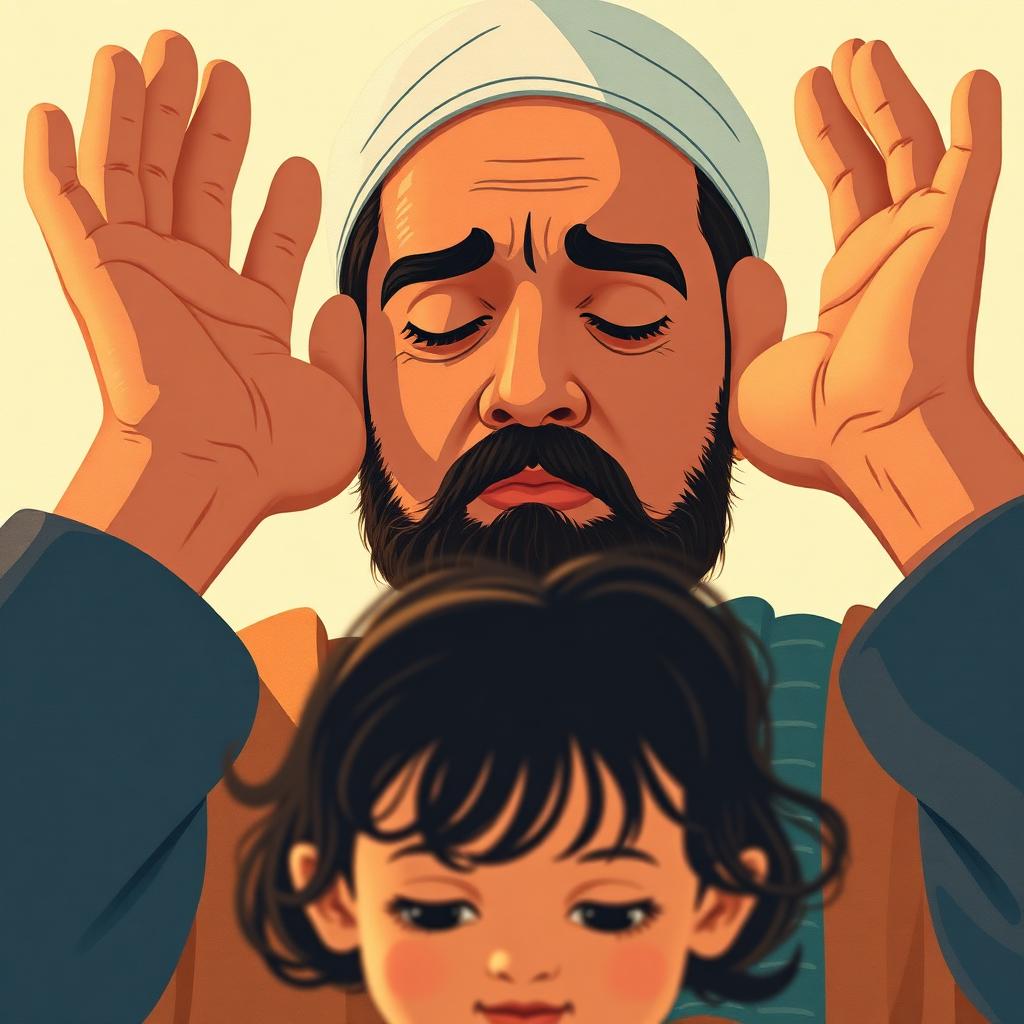
Here is what nobody realised.
Aisha was watching.
She could not talk, so everybody assumed she was not paying attention. That is the mistake grown-ups make about babies roughly one hundred percent of the time.
She was paying ferocious attention.
She watched her father's hands go up beside his ears. She watched him fold them. She watched him bend — slowly, carefully, hands on his knees — and then stand back up again.
She watched him go all the way down to the floor and put his face on the ground.
She watched Mama Saff do it too, in her long soft prayer clothes, in the same place, at the same times, every single day of Aisha's entire life.
And she watched them turn their heads at the end — right, then left — and say something to somebody she could not see.
She did not know it was called salah. She did not know what a rakah was. She had no idea, at eighteen months old, that she was watching the second pillar of Islam.
She only knew one thing, and it went right down into the bottom of her, deeper than words go:
This is what we do. This is who we are.
The Day She Stood Up
It happened on an ordinary Tuesday.
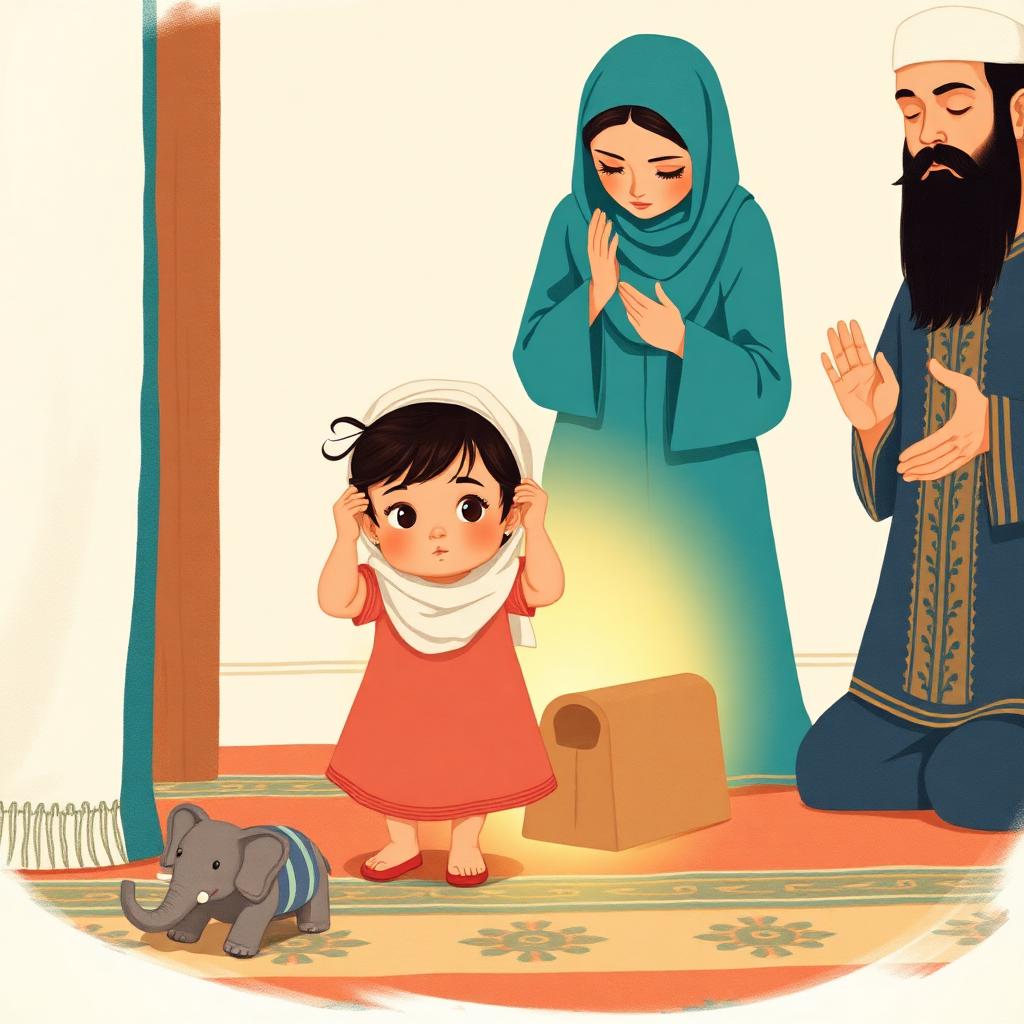
Maghrib. Baba Omar in front. Mama Saff behind him. And Aisha on the carpet with a plastic elephant and no plans whatsoever.
And then —
she put the elephant down.
She hauled herself up onto her feet, the way toddlers do — with enormous effort and a small grunt, like a tiny weightlifter — and she toddled over, and she stood behind her mother.
And she put her hands up beside her ears.
Mama Saff nearly lost her prayer completely.
Because that little person — who could not say the word "prayer," who could not say her own surname, who had eleven words and four of them were "no" —
was doing it.
She bent when they bent. Her little bend was less of a bend and more of a sort of enthusiastic wobble.
She went down when they went down. Her sujud involved putting her forehead somewhere in the general vicinity of the floor and then immediately looking around to check she was doing it right.
She stood up when they stood up, roughly, mostly, eventually.
And at the end, she turned her head to the right, and then to the left — with total, solemn, eighteen-month-old seriousness — to say salam to somebody she could not see.
Nobody had ever taught her a single movement of it.
Not one. Not once.
She had stolen every bit of it with her eyes.
The Girl Who Gets Ready
And after that, something began to happen in that house that changed everything.
The athan clock would go off.
And before Baba Omar had even stood up — before Mama Saff had put down what she was holding —
Aisha was already going.
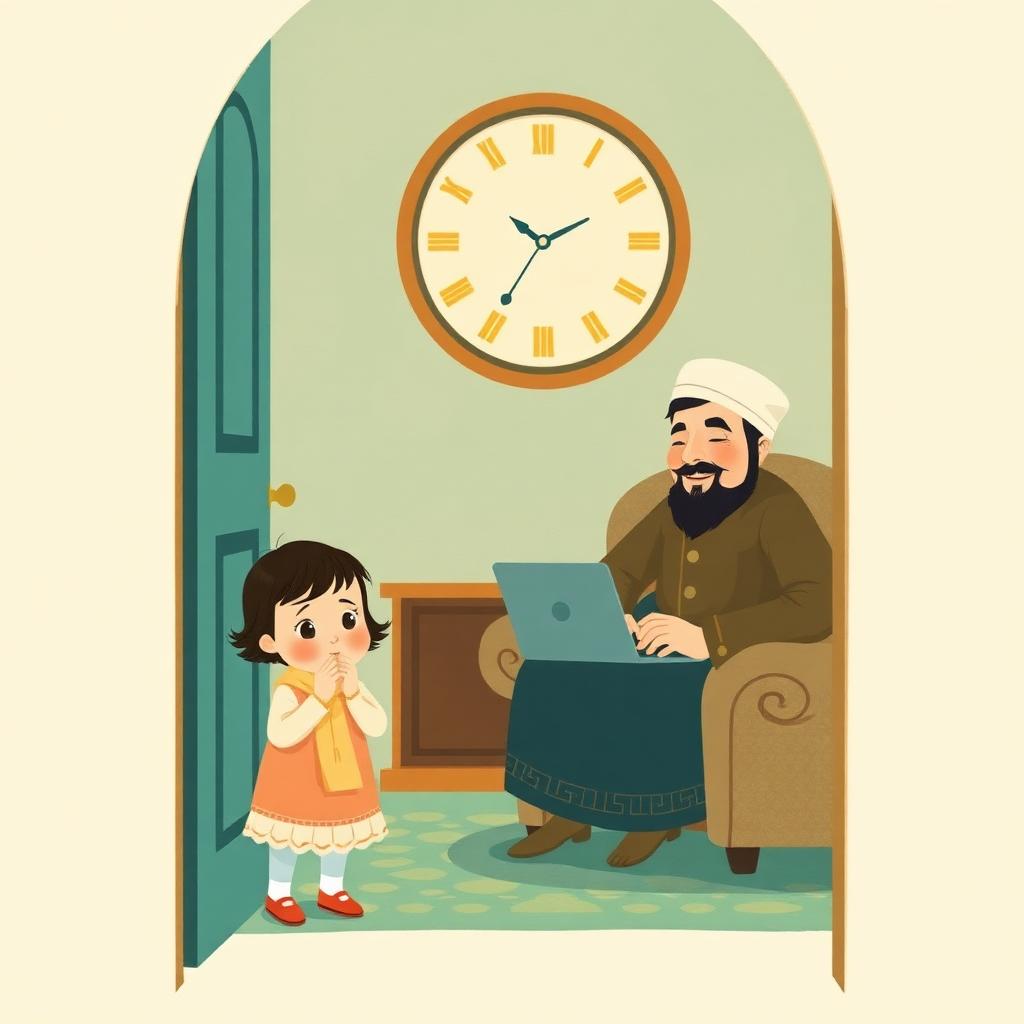
She would stop whatever she was doing. She would drop the elephant. And she would toddle off, at speed, with tremendous purpose, to fetch the little scarf her grandmother had sent her.
Then she would come back and stand in the spot. Her spot. And she would wait.
And if the grown-ups were slow — if Baba was still finishing an email, if Mama Saff was still stirring a pot of laghman, or pulling a tray of hot samsa out of the oven, or folding the dough for tomorrow's polo —
she would look at them.
Just look.
Something had happened in that house.
The baby had become the reminder.
A person who could not form a sentence was now, silently, calling her own parents to prayer with nothing but a small scarf and an expectant face.
And there were days — real days, tired days, days when the sofa was very comfortable and Isha was very far away — when the only thing that got Baba Omar up off that sofa was an eighteen-month-old standing in the doorway holding her scarf, waiting.
The Steps
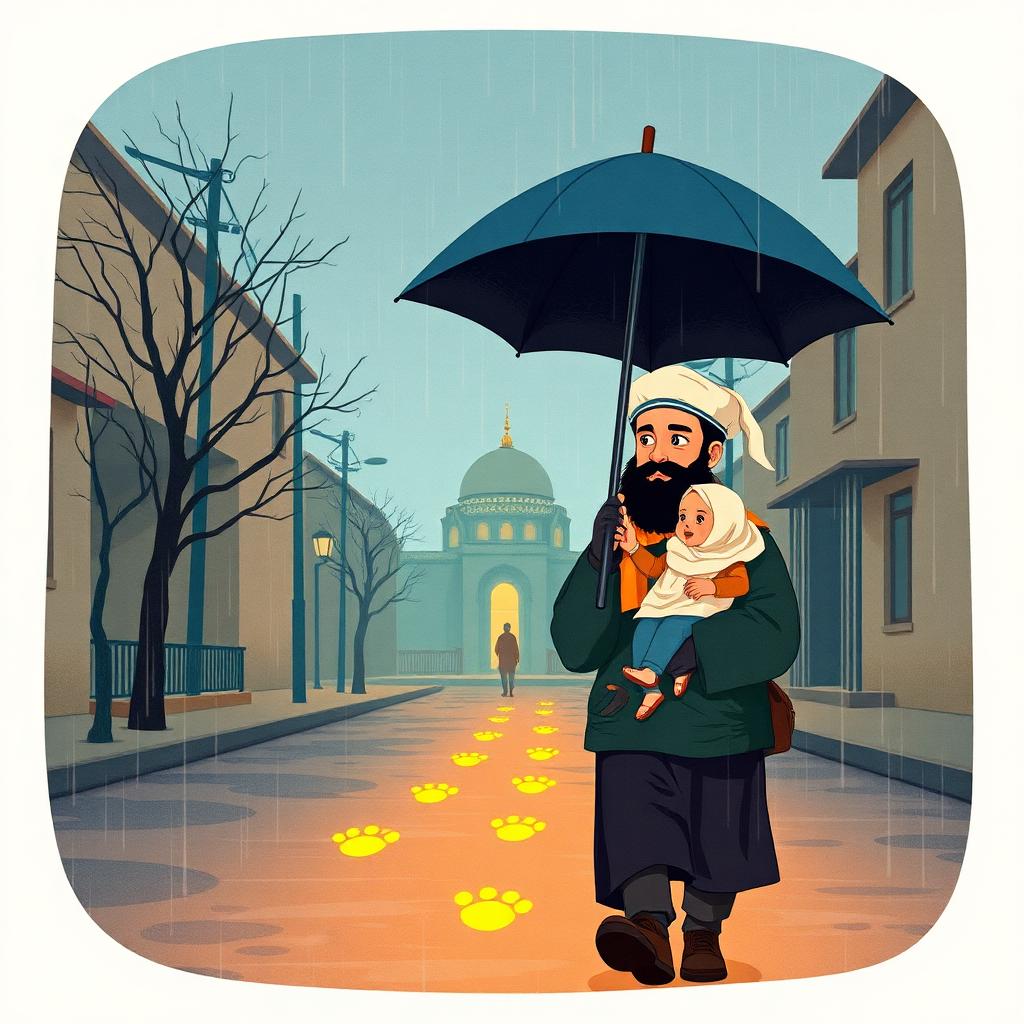
Baba Omar loved showing her.
So he started taking her with him.
He would carry her out of the door — small scarf, small shoes, entirely delighted — and they would walk to the masjid together.
And on the way, something was happening that Aisha could not possibly have understood, but which her father understood perfectly, because the Prophet ﷺ had told the ummah about it:
“He who purifies himself in his house, and then walks to one of the houses of Allah to perform an obligatory prayer — one step of his will wipe out a sin, and another step will elevate his rank.”
— Sahih Muslim
Every single step.
One step: a sin, gone. Next step: a rank, higher. One step. Two step. One step. Two step.
All the way down an ordinary street, past an ordinary bus stop, on an ordinary evening.
There was nothing ordinary about that walk at all.
And there was another part that made Baba Omar smile — the Prophet ﷺ had said that the person who lives the furthest away gets the greatest reward.
Not the one who lives closest and pops in.
The one who walks the longest.
So on the days when it was raining, and cold, and Baba Omar's whole body wanted to stay home — he would look down at the small person holding his finger, and he would think:
Her qizim. Every step, qizim — my daughter. Every single step.
And out they went.
Twenty-Seven

And then they arrived.
And Aisha — one and a half years old, small enough to be carried in one arm — was taken into a room full of grown men.
And she was welcome.
And this is a thing many people have got wrong: the Prophet ﷺ himself used to pray with children in his arms. He would carry his granddaughter Umamah in the prayer — pick her up when he stood, and put her down when he made sujud.
He ﷺ made the prayer shorter once because he heard a baby crying, so as not to distress the mother.
Children in the masjid are not a problem to be managed.
They are the whole point.
And here is why Baba Omar carried his daughter down that street, in the rain, when he could have prayed perfectly well on his own carpet at home:
“The prayer in congregation is twenty-seven times more excellent than the prayer of a man by himself.”
— Sahih al-Bukhari; Sahih Muslim
Twenty-seven times.
Not twenty-seven percent better. Twenty-seven times.
The same movements. The same words. The same amount of your evening.
Multiplied by twenty-seven — because you got up, and you walked, and you stood shoulder to shoulder with people whose names you do not always know.
And a very small girl stood in that room, wobbling, doing her enthusiastic bend, in a row of grown men who all smiled and made space —
and something went into her that no lesson could ever have put there:
I belong in this room.
The Thought That Kept Her Mother Awake
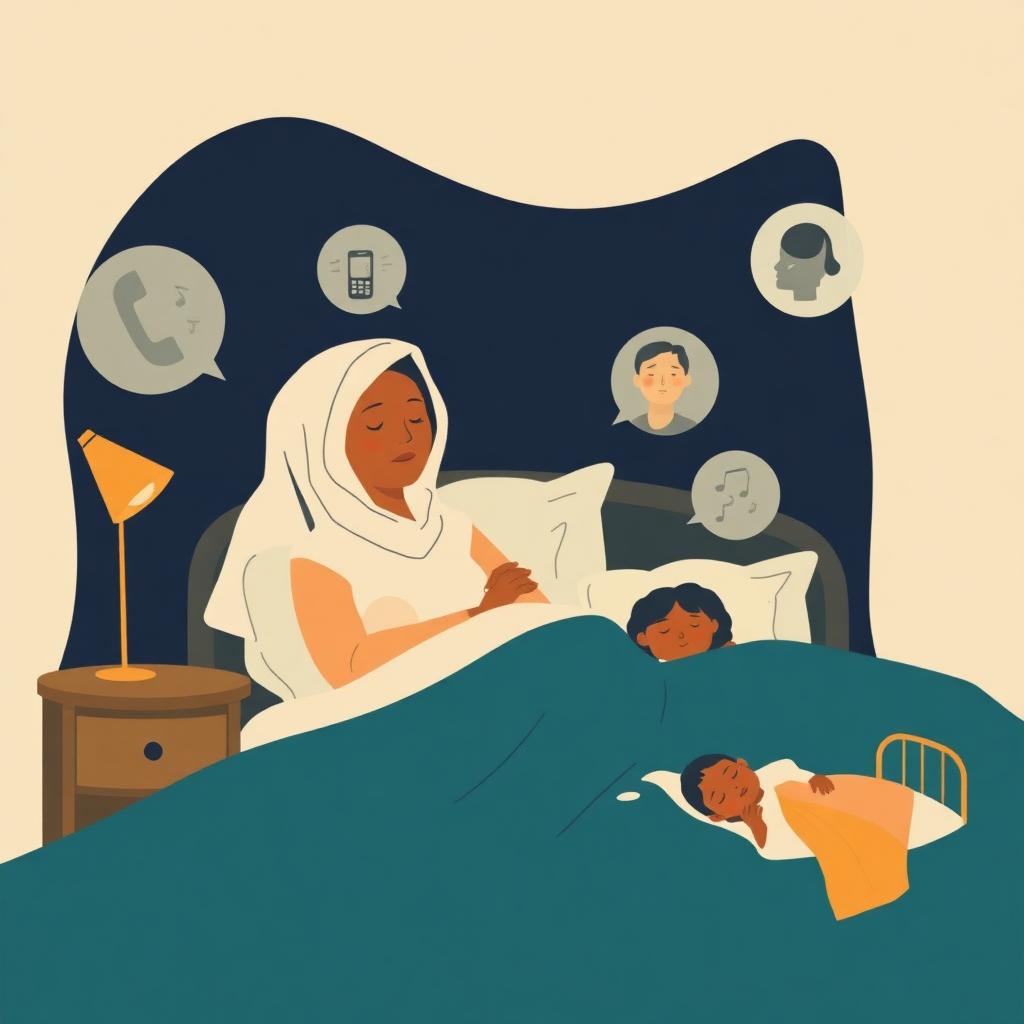
And here is the part of this story that is not soft — the part that kept Aisha's mother awake one night.
She lay in the dark and thought: my daughter has never had a single lesson.
Not one. She cannot understand a lesson. She has eleven words.
Everything she knows, she took by watching.
And then came the thought that sat her straight up in bed:
What ELSE is she watching?
Because if a child that small can learn the entire shape of the salah — the hands, the bend, the sujud, the turn of the head — with nobody teaching her…
then she is also learning how we speak to each other when we are tired.
She is learning what our faces do when the phone rings.
She is learning whether the adhan is something you jump for, or something you finish your programme first.
She is learning whether we are gentle when nobody is looking.
She is learning all of it, all the time, and she cannot be lied to, because she cannot understand words yet.
She can only understand what we actually do.
And this — this — is why the Prophet ﷺ said the thing he said. His words were chosen with perfect precision:
“Pray as you have seen me pray.”
— Sahih al-Bukhari
Not as you have heard me describe.
Not as I explained it to you that time.
As you have SEEN me pray.
That is how this deen was carried, from him ﷺ, to the companions, to their children, to their children, all the way down fourteen hundred years to a carpet in a small house with an athan clock on the wall.
Not by lecture. By sight.
The Du'a of Ibrahim
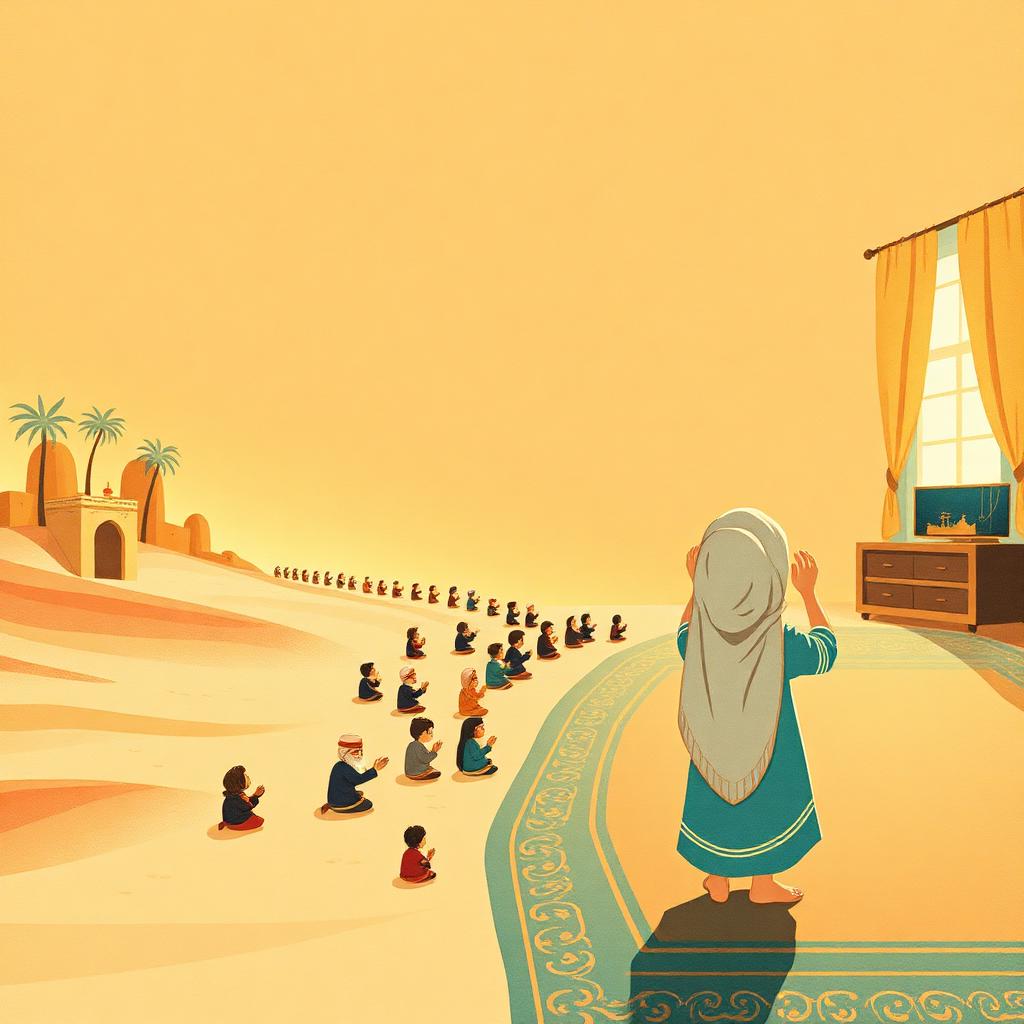
There is a du'a in the Quran that a prophet made thousands of years ago, and it is not possible to read it in the same way once you have watched a toddler put her hands up beside her ears.
It is the du'a of Ibrahim (alayhi salam), and he did not ask to be a good man.
He asked for something much bigger:
رَبِّ اجْعَلْنِي مُقِيمَ الصَّلَاةِ وَمِن ذُرِّيَّتِي ۚ رَبَّنَا وَتَقَبَّلْ دُعَاءِ
“My Lord, make me an establisher of prayer, and from my descendants. Our Lord, and accept my supplication.”
— Surah Ibrahim (14:40)
Notice what he asked for.
Not just let me pray.
And from my children. And their children. And their children.
He was not asking for a good deed. He was asking for a chain.
And Allah tells us how the chain is actually made — and He does not say tell your family:
وَأْمُرْ أَهْلَكَ بِالصَّلَاةِ وَاصْطَبِرْ عَلَيْهَا
“And enjoin prayer upon your family, and be steadfast therein.”
— Surah Ta-Ha (20:132)
Wastabir 'alayha. And be steadfast in it — yourself.
Steadfast. In front of them.
That was the whole instruction. Allah did not say make them do it.
He said: do it, and keep doing it, and do not stop — where they can see you.
And so, in a small house with an athan clock on the wall, that is what Baba Omar and Mama Saff kept on doing.
They stood up when the adhan went.
Even when they were tired. Even when the sofa was comfortable. Even when nobody would ever have known.
Because somebody did know.
She was on the carpet with a plastic elephant.
And she was watching everything.
Seventeen Times a Day
How a chain gets made. Nobody is too small, and nobody is too late.
- Put the athan on out loud — not a silent buzz on a phone. The sound is the invitation. Let it fill the house.
- Stand up immediately — not at the end of the programme. What you do in the ten seconds after the adhan is the lesson.
- Give them a spot — a small mat, a small scarf, a place that is theirs beside you.
- Let them ruin it — the wobbling, the climbing, the sujud in the wrong direction. The Prophet ﷺ prayed with a child on his shoulders. Your prayer is not spoiled. It is being inherited.
- Take them with you — every step to the masjid wipes a sin, every step raises a rank, and the one who walks furthest gets the most.
- Never pray alone if you can pray together — twenty-seven times. Twenty-seven.
- And be steadfast yourself — because wastabir 'alayha was never an instruction about them. It was always an instruction about you.
رَبِّ اجْعَلْنِي مُقِيمَ الصَّلَاةِ وَمِن ذُرِّيَّتِي ۚ رَبَّنَا وَتَقَبَّلْ دُعَاءِ
Rabbi-j'alni muqeemas-salati wa min dhurriyyati, Rabbana wa taqabbal du'a.
My Lord, make me an establisher of prayer, and from my descendants. Our Lord, and accept my supplication.
O Allah — let the salah be the first thing they saw, and the last thing they leave. Make it heavy on our scales and easy on our feet. And Ya Allah, when they are grown and we are gone, let them stand in a row somewhere in this world and remember, without even knowing why, that this is simply what we do.
Ameen.
For families with somebody small watching
- 1
Start before they can understand. Aisha never had a lesson. She had a life. You do not need to wait until they can follow an explanation — by then, they have already learned it, one way or the other.
- 2
Make the adhan a starting gun, not background music. The lesson is not the prayer. The lesson is how fast you get up.
- 3
Give them a job. Fetching the mat. Fetching the scarf. Turning off the TV. A child with a job at prayer time is a child who owns the prayer.
- 4
When they are seven, ask them properly. The Prophet ﷺ said: "Command your children to pray when they are seven." (Sunan Abi Dawud) By then, insha'Allah, you are not introducing something strange. You are naming something they have watched their whole lives.
- 5
Explain it small, and explain it true. Not "because you'll be punished." Try: "Five times a day, Allah invites you to come and talk to Him. Nobody else gets to say what you say. That is your appointment. It is the best five minutes of your day."
- 6
Reward the standing, not the perfection. For an older child: a chart, a Friday treat, choosing dinner, an outing for a full week. But make the celebration about showing up — because that is the only part that has to last a lifetime.
- 7
And when you are exhausted — get up anyway. That is the lesson. That has always been the lesson. Somebody small is on the carpet, and she is not listening to a word you say.