The Rope Tied to His Name
a story about the family you cannot see
by Rayda Edding
Bismillah ir-Rahman ir-Raheem.
بِسْمِ اللَّهِ الرَّحْمَٰنِ الرَّحِيمِ
For a boy in Switzerland who counts in Swiss-German.
The Boy in the Snow

Ibrahim was three years old, and he lived in Switzerland, where the mountains are so tall and so white that they look like Allah drew them and then pressed down hard.
His world was small and perfect, and it had exactly six things in it.
Lego — which he did not build houses with. Oh no. Ibrahim built machines. Enormous, complicated, entirely-made-up machines with a purpose he would explain at length, in three languages, whether anybody had asked or not.
Books — stacks of them, from Inah. Ibrahim could not properly read yet. This did not slow him down even slightly. He read the pictures the way other people read words, and he remembered everything.
A trampoline, also from Inah, on which he could bounce for forty minutes without stopping while shouting facts about volcanoes.
A grasshopper. A small green toy grasshopper, extremely important, entirely irreplaceable, and required for sleeping.
Mama Tasneem, who stayed home and took care of the whole family, and always had a warm meal ready and a lap free for a small boy who needed one.
And Baba Bilaal, who was — and this is the thing that mattered most in this whole story — always, always on the phone to his parents, very far away, checking on them.
The Boy Made of Places
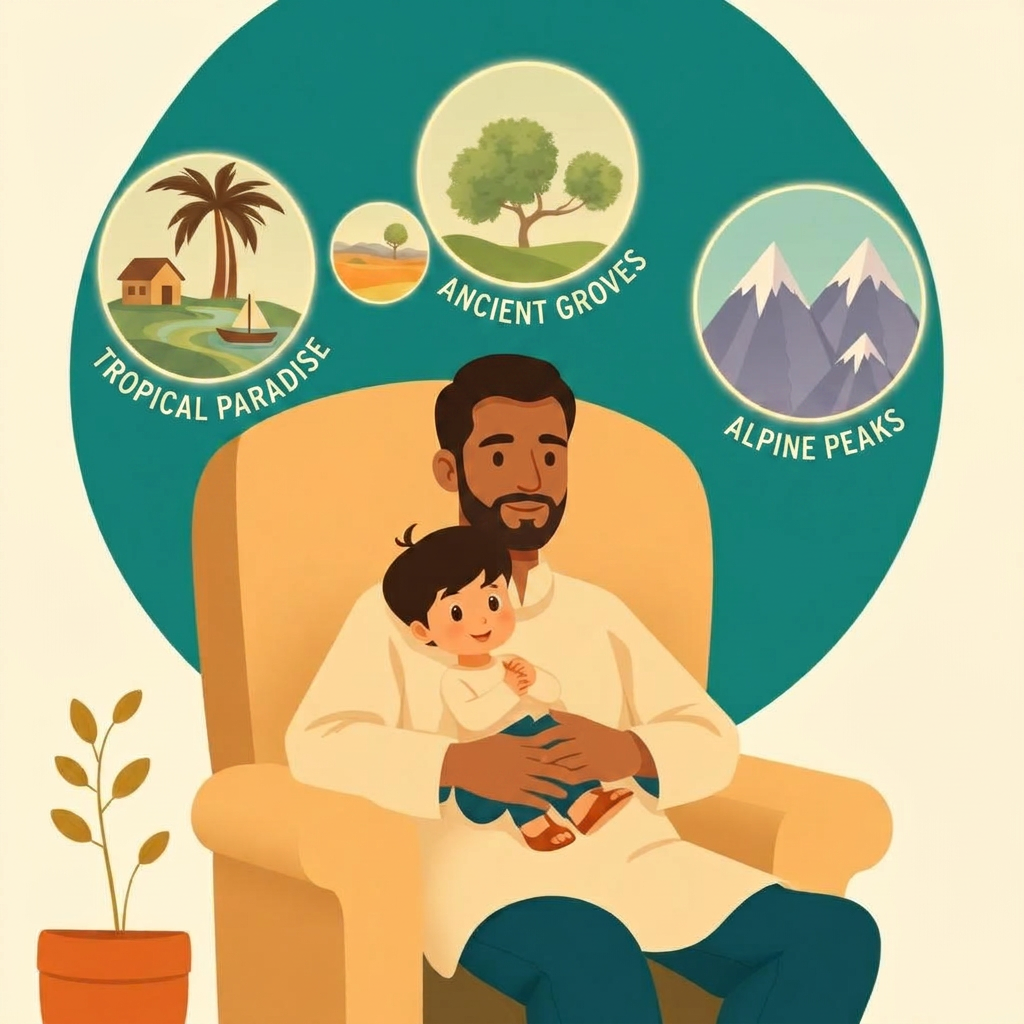
At three years old, Ibrahim noticed something that most people do not notice until they are much older.
Everybody in his family came from somewhere different.
Baba Bilaal's family came from India — his mother and father, and their parents before them, going back and back like a long line of open doors.
Mama Tasneem's family came from the Philippines and from Syria — her own mother had crossed a wide ocean, and her own father had grown up in a land of olive trees.
And Ibrahim was born in Switzerland, and counted his Lego bricks in Swiss-German, because that is what the children in the park did.
One evening he climbed onto his father's lap and asked the enormous question that his tiny three-year-old brain had clearly been chewing on for some time:
"Baba. What am I?"
And Baba Bilaal did not laugh at him.
He thought about it for a long moment, the way you should when a small person asks you the biggest question in the world.
Then he said: "Habibi. You are a rope."
Ibrahim looked down at himself. He did not appear to be a rope.
"Not that kind. Come here — I'll show you what I mean. But you have to listen with your whole face."
Asiya
But first, there was the seventh thing in Ibrahim's world, because she had arrived quite recently and she had changed absolutely everything.
Her name was Asiya, and she was a few months old, and she was — in Ibrahim's professional opinion — fascinating.
She could not build. She could not bounce. She could not say one single word about volcanoes.
She could only lie there and wave her arms about like a very small, very confused octopus.
And Ibrahim loved her with a fierceness that startled everybody.
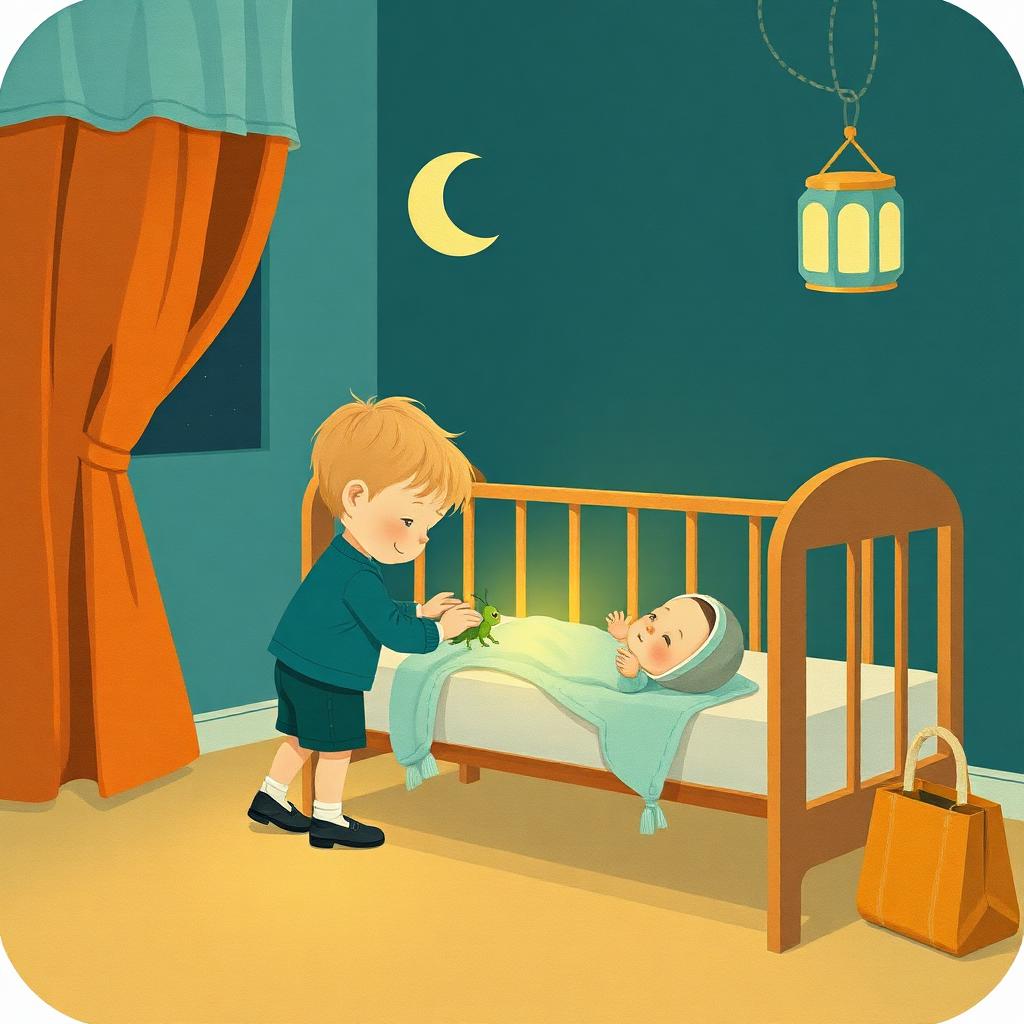
He checked on her roughly nine hundred times a day. He announced her every burp to the entire household like a town crier. If she cried and nobody moved fast enough, he would stand over her cot and shout, with genuine outrage: "MAMA! ASIYA IS SAD!"
And one night — this is the moment his mother told everybody about for years —
Asiya was crying, and nothing was working, and Ibrahim toddled over, and he looked at her for a long moment.
And then he gave her the grasshopper.
The grasshopper. The irreplaceable one. The one required for sleeping.
He put it in her cot and patted it twice and said, very seriously: "For you."
Then he went to bed without it, and did not sleep very well, and did not complain once.
That was the first rope Ibrahim ever tied.
He was three.
The Word That Comes From Allah's Own Name
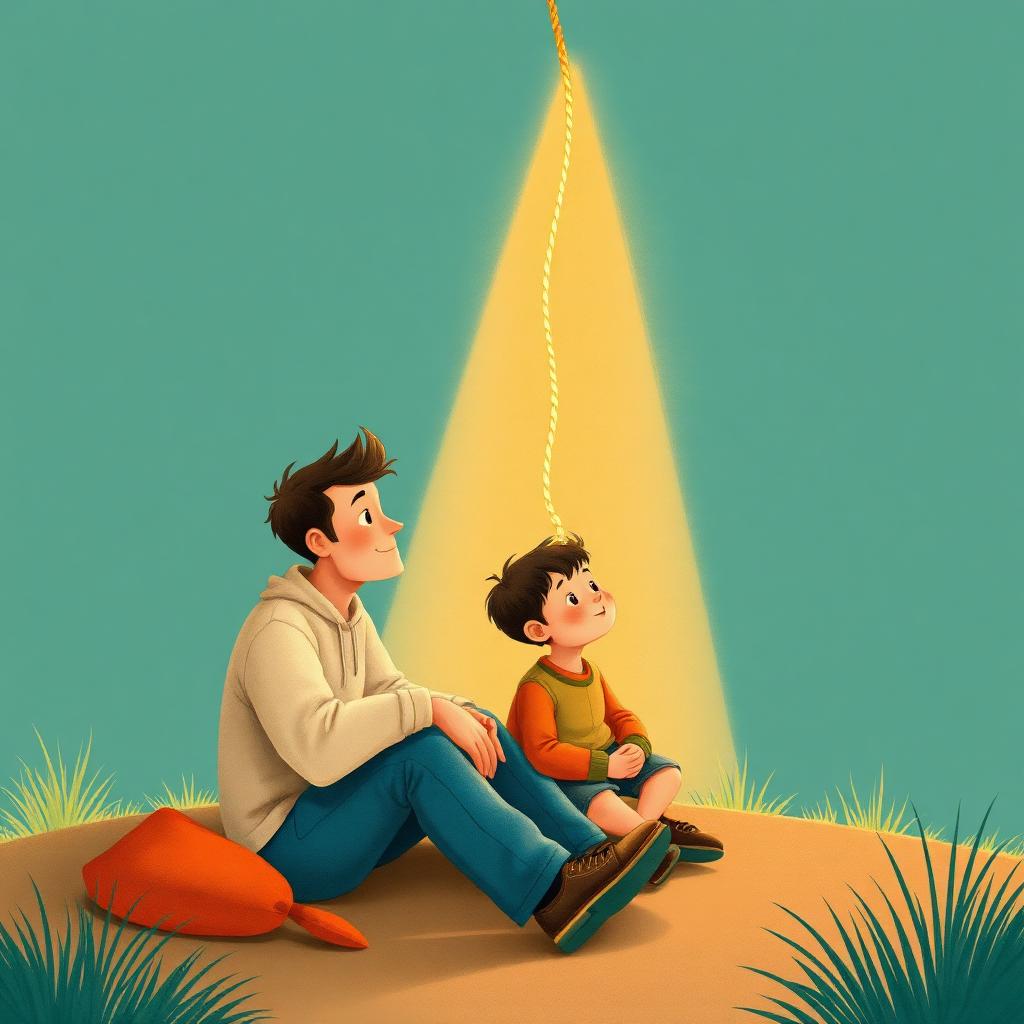
The next evening, Baba Bilaal put Ibrahim on his lap and finally explained the rope.
"Habibi. In Arabic, do you know what we call your family? Your grandmother, your grandfather, your auntie, your cousins — all of them?
We call them your rahim.
And Ibrahim — listen — that word does not come from nowhere.
It comes from the name of Allah Himself.
Ar-Rahman. The Most Merciful. Ar-Raheem. The Especially Merciful.
Your family tie is called rahim because Allah took a piece of His own Name and He gave it to your family.
Listen to what our Prophet ﷺ said:"
“Allah said: "I am Ar-Rahman. I created the rahim (the ties of kinship) and I gave it a name derived from My own Name. So whoever keeps it, I will keep him — and whoever cuts it off, I will cut him off."”
— Sahih al-Bukhari; Sunan At-Tirmidhi
Ibrahim did not understand all of that. He was three.
But he understood the important bit, because his father said it very slowly, holding both his hands:
"Ibrahim. Your family is a rope.
And Allah tied one end of it to His own Name.
So when you hold on to your family, habibi — do you know what you are actually holding on to?"
Ibrahim's eyes went very wide.
And Allah says it in the Quran, in an ayah so serious that it comes right at the start of a whole surah — where He puts two things together, side by side, as if they cannot be separated:
وَاتَّقُوا اللَّهَ الَّذِي تَسَاءَلُونَ بِهِ وَالْأَرْحَامَ
“And fear Allah, through whom you ask one another — and the wombs (the ties of kinship).”
— Surah An-Nisa (4:1)
"Do you see it, Ibrahim? He put your grandmother in the same sentence as Himself."
Dada and Dadi
Which is why, two or three times a year, a very strange and wonderful thing happened.
Baba Bilaal would come home and say: "Pack the small bag, ya Ibrahim."
And they would fly — Mama, Baba, Ibrahim, and Asiya (who screamed for exactly one hour and then slept like a champion) — all the way to Turkey.
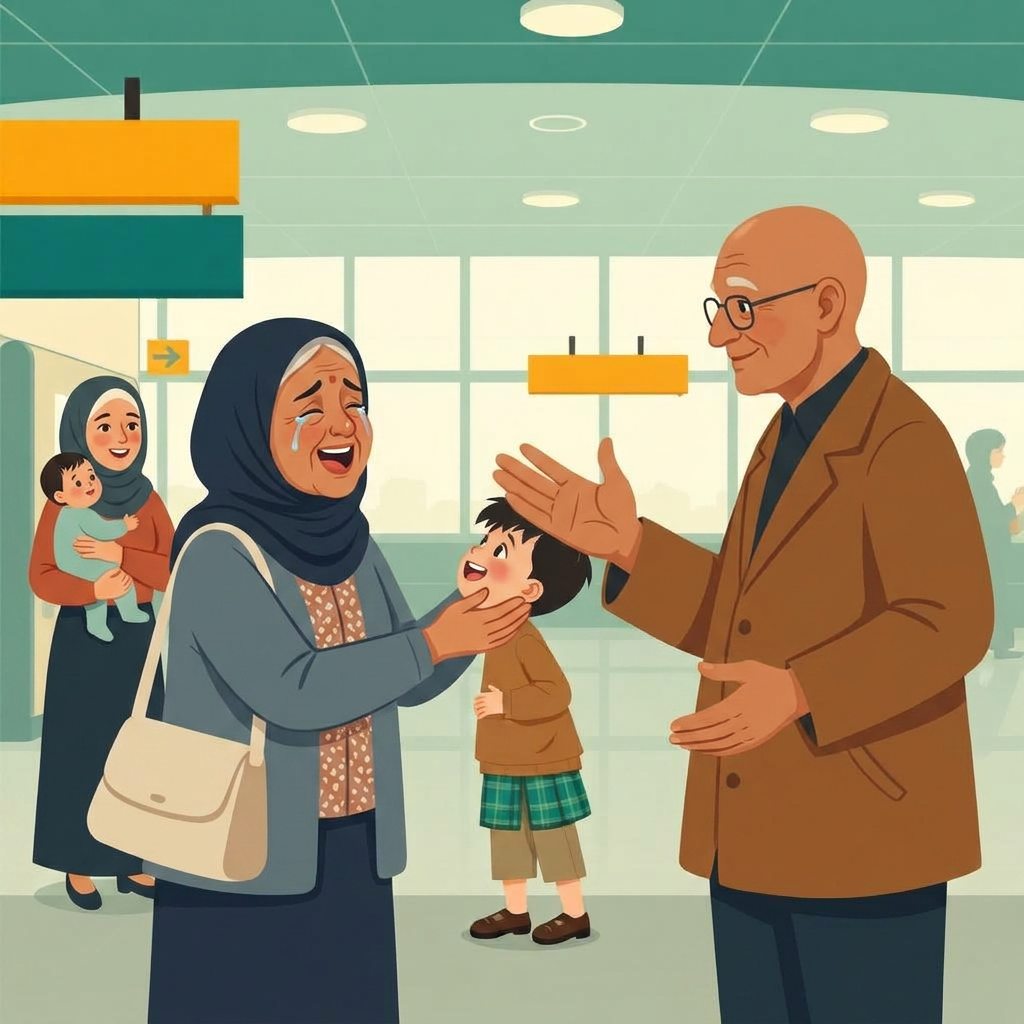
Where Dada and Dadi were waiting at the airport.
There was nothing quite like Dadi at an airport. That woman could spot her grandchildren through a wall. She started crying before they got through the doors. She held Ibrahim's face in both her hands and said his name about forty times, as though she were checking that it still worked.
And Dada — who did not say much — simply put out one huge hand, palm up.
And Ibrahim, who was three years old and who had been taught this before he could even walk properly, took that hand and lifted it and kissed it.
And then pressed it to his own forehead.
Because that is what Baba Bilaal did. Every single time. His grown father, in front of everybody, taking his own father's hand and kissing it like a boy.
That is not something taught with a lecture.
It is taught by doing it in front of somebody who is three.
And this is what Allah says about the old people who raised the people who raised you:
وَاخْفِضْ لَهُمَا جَنَاحَ الذُّلِّ مِنَ الرَّحْمَةِ وَقُل رَّبِّ ارْحَمْهُمَا كَمَا رَبَّيَانِي صَغِيرًا
“And lower to them the wing of humility, out of mercy, and say: 'My Lord, have mercy upon them as they raised me when I was small.'”
— Surah Al-Isra (17:24)
The wing of humility.
Like a great bird folding its wing down, gently, so that something small and precious can climb underneath it.
That is how Baba Bilaal walked into his parents' house. Every time. A grown man with a job and a family and grey coming into his beard —
folding his wing all the way down.
Shoulder to Shoulder
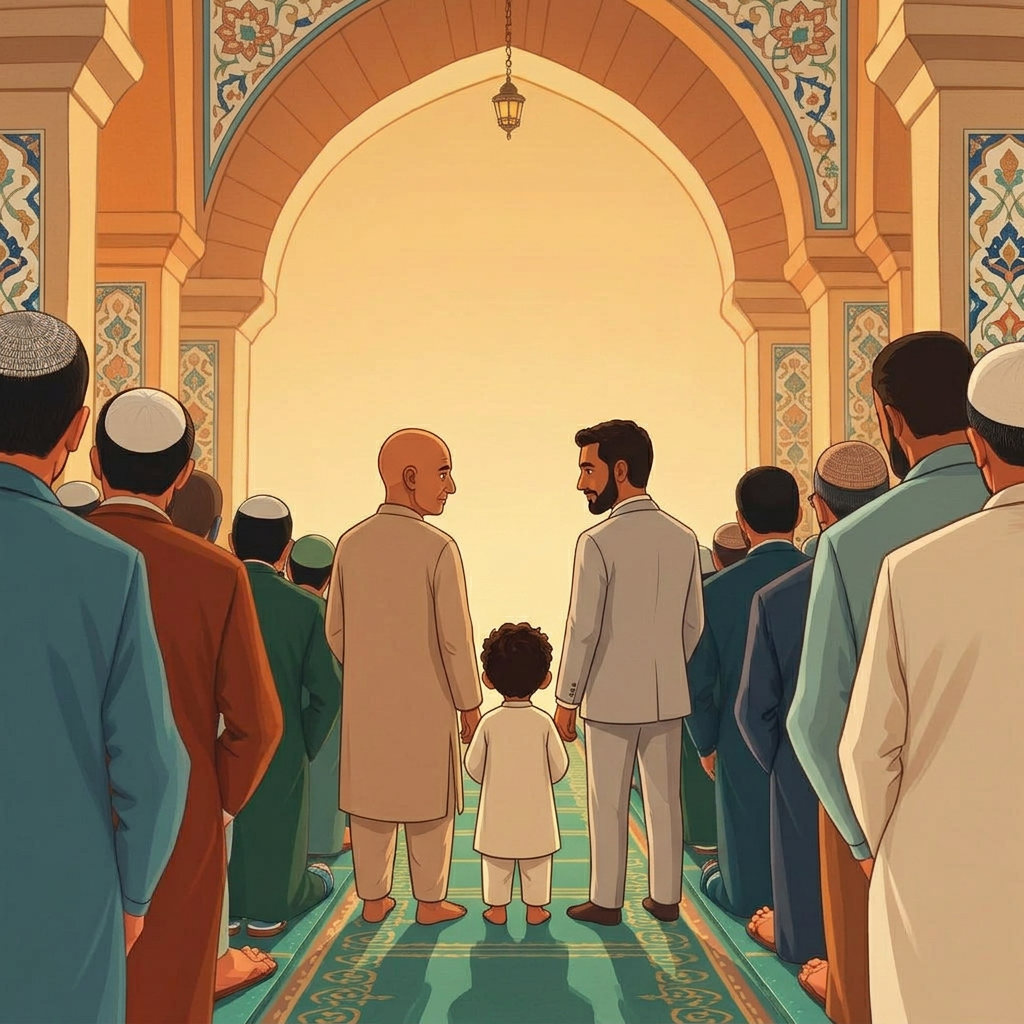
On the Friday, something happened that Ibrahim waited for all week.
Baba Bilaal put on his best clothes, and he put the good perfume on Ibrahim's collar, and he said the four words:
"Come. It's Jumu'ah."
And they went — Baba, Dada, and a three-year-old boy walking between two grown men, holding one enormous hand on each side — through the old streets, to the masjid.
(Mama Tasneem and Dadi came too, with Asiya, who slept through the entire khutbah, which is more than can be said for some of the uncles.)
And when the prayer began, Ibrahim stood in the row.
And a row is a curious thing.
It is a place where nobody is in front of anybody. Where the man who owns the shop stands shoulder to shoulder with the man who sweeps outside it. Where a boy of three, in his good clothes, smelling of his father's perfume, stands with his small shoulder touching his grandfather's leg —
and nobody in the entire room is more important than anybody else.
Ibrahim did not do the prayer correctly. He was three. He bobbed up and down at approximately the right times and scratched his ear during the sujud and spent a portion of the second rakah examining the carpet pattern very closely.
Nobody minded even slightly.
Because they were not there for his prayer.
They were there so that in thirty years, when Ibrahim walks into a masjid anywhere on this earth — Zurich, Istanbul, Manila, anywhere —
his body will already know: I have always belonged here.
The Stones That Remember
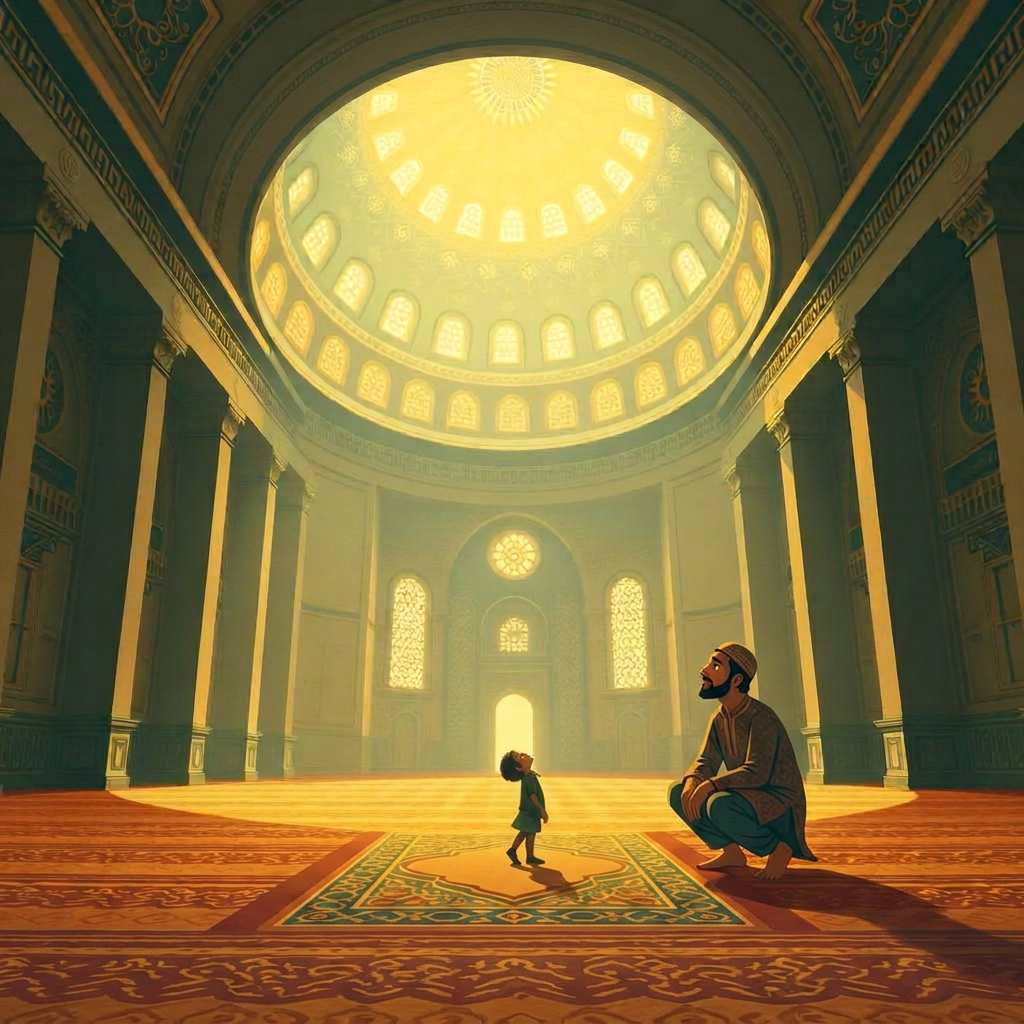
And then Baba Bilaal took him to see the old stones.
Great domes. Courtyards with fountains in the middle. Walls that had been standing so long that the corners had gone soft and round, the way a bar of soap goes.
Mosques built by the Ottomans — hundreds and hundreds of years ago — with ceilings so high and so full of light that a three-year-old boy stopped talking. Which, if you knew Ibrahim, was a miracle roughly on the scale of the Red Sea.
He stood in the middle of the floor and looked straight up, all the way up, with his mouth open.
"Baba." He pointed. "Who made it?"
And Baba Bilaal crouched down beside him.
"Muslims made it, habibi. People like us. They loved Allah, and so they built something beautiful — and then they died, and the building stayed. It has been standing here for five hundred years."
Ibrahim thought about that for a long moment, with his three-year-old brain, standing in a room made of light.
And here is why Baba Bilaal brought him — the same reason he took him to the masjid, and the same reason they flew across a continent to kiss an old man's hand:
Because a child who thinks Islam is only a rule in his house will drop it the moment he leaves the house.
But a child who has stood inside it — who has felt his own voice bounce off a five-hundred-year-old ceiling, who has stood shoulder to shoulder in a row, who has kissed the hand of the man who raised the man who raised him —
that child is not carrying a rule.
That child is carrying a home.
And a home cannot be left behind. It travels with a child everywhere, even to Switzerland, even to a park where all the children count in Swiss-German.
The Rope
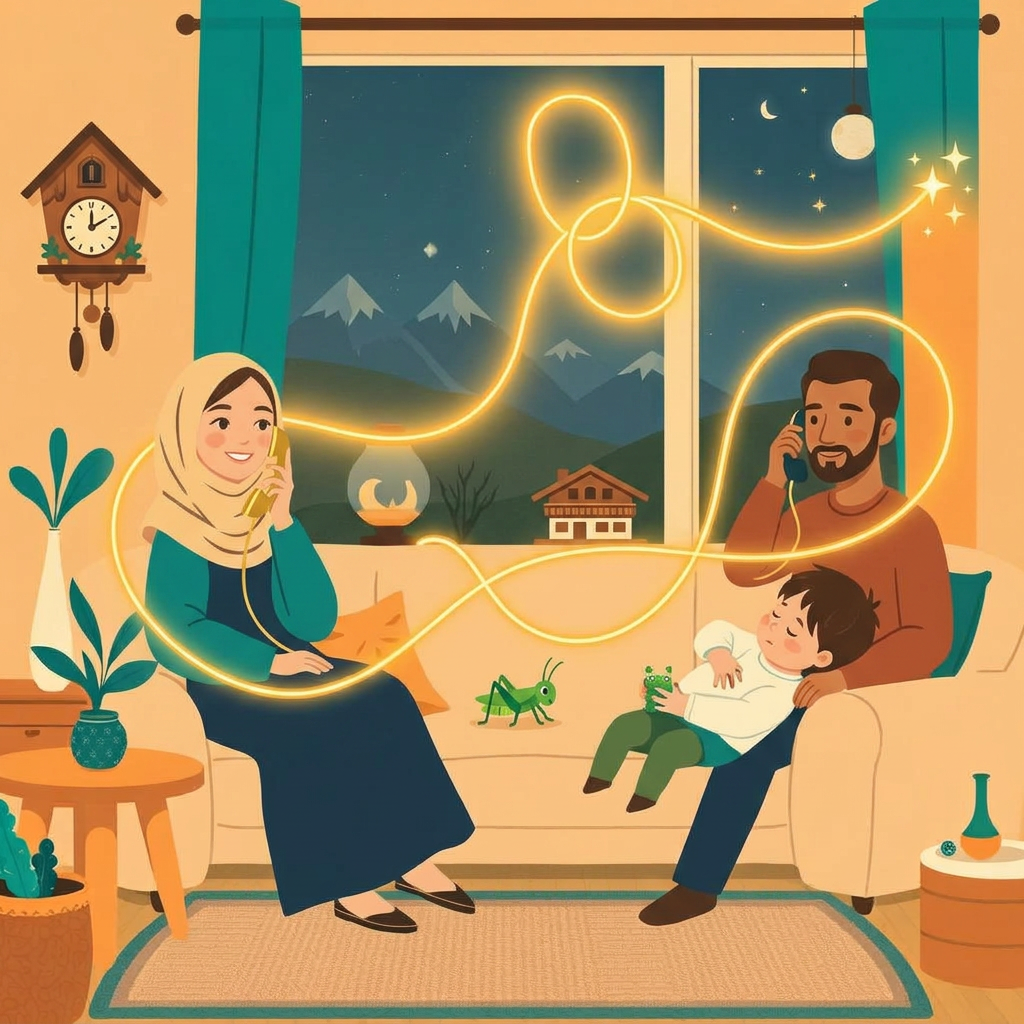
They flew back to the snow.
And the very first thing Mama Tasneem did when they landed — before she had even taken her coat off — was pick up the phone and call Dadi to say we arrived safely.
And then she called Inah, far away on the other side of the world, to tell her about it.
And then Baba Bilaal walked next door to his sister — who lived just on the other side of the wall — to tell her they were home.
And Ibrahim — three years old, half asleep, still holding his grasshopper — watched all of it from the sofa.
He did not have the words for what he was seeing. He would not have the words for another twenty years.
But he understood it completely.
These people are always, always pulling on a rope.
Every phone call. Every long flight with a screaming baby. Every hand kissed at an airport. Every "we arrived safely."
They never let go of it. Not for one week. Not once.
And the Prophet ﷺ made an extraordinary promise about people who hold on to that rope — one of the most remarkable promises in all of Islam:
“Whoever would like his provision to be increased, and his lifespan to be extended — let him maintain his ties of kinship.”
— Sahih al-Bukhari; Sahih Muslim
More rizq. A longer life.
Just for phone calls. Just for showing up. Just for not letting go.
Ibrahim had a rope.
It reached out of his chest and went to his mother, and his father, and Dadi, and Inah, and Dada, and the uncle who annoyed everybody at Eid, and the cousins he had not yet met.
Some of the strands were strong. Some had gone thin with distance. But the other end of the rope was not tied to any of them.
It was tied to His Name.
"Whoever keeps it — I will keep him."
So they picked up the phone. They got on the plane. They kissed the hand. They gave away the grasshopper.
They were not just being nice to their family.
They were holding on to Allah.
Ways to Pull the Rope
You do not need to be big. Ibrahim was three.
- Call one person today — the one you have not called. Not a long call. A short one. Short counts.
- Kiss the hand of somebody old — and mean it. Then watch what it does to their face.
- Say “we arrived safely” — every time. It costs eleven seconds and it tells somebody far away that they still live in your head.
- Give away your grasshopper — the good one. The irreplaceable one. To the person nearest to you who is sad.
- Be the one who does not let go — even if the other end has gone quiet. “He is not the one who keeps ties out of return. The one who keeps ties is the one who, when his ties are cut, restores them.” (Sahih al-Bukhari)
رَبِّ ارْحَمْهُمَا كَمَا رَبَّيَانِي صَغِيرًا
Rabbi-rhamhuma kama rabbayani sagheera.
My Lord, have mercy upon them as they raised me when I was small.
O Allah, keep our family ties strong when the distance is long and the years are many. Bless the ones who came before us and let us be a coolness to their eyes. And Ya Allah — You said that whoever keeps the rahim, You will keep him. So keep us, Ya Rahman. Do not let us be the ones who let go.
Ameen.
For little rope-holders to try
- 1
Learn where your face comes from. Ask your parents which countries are in you. Then say them out loud, all of them. You are not from one place. You are made of places — and every one of them was Allah's idea.
- 2
Check on the smallest person in your house. Nine hundred times a day if you have to. Being a big brother or big sister is your first, hardest, most important job.
- 3
Kiss the hand. Every time you see your grandparents. Do not be shy. Fold your wing all the way down — Allah put that instruction in the Quran, and He does not waste words.
- 4
Stand in the row. Even if your prayer is wobbly. Even if you scratch your ear during sujud. Your body is learning something your brain will need later: I belong here.
- 5
Never be the one who lets go. Even if the other person stopped calling. Especially then. The one who keeps ties is not the one who returns a favour — it is the one who restores a rope that somebody else cut.